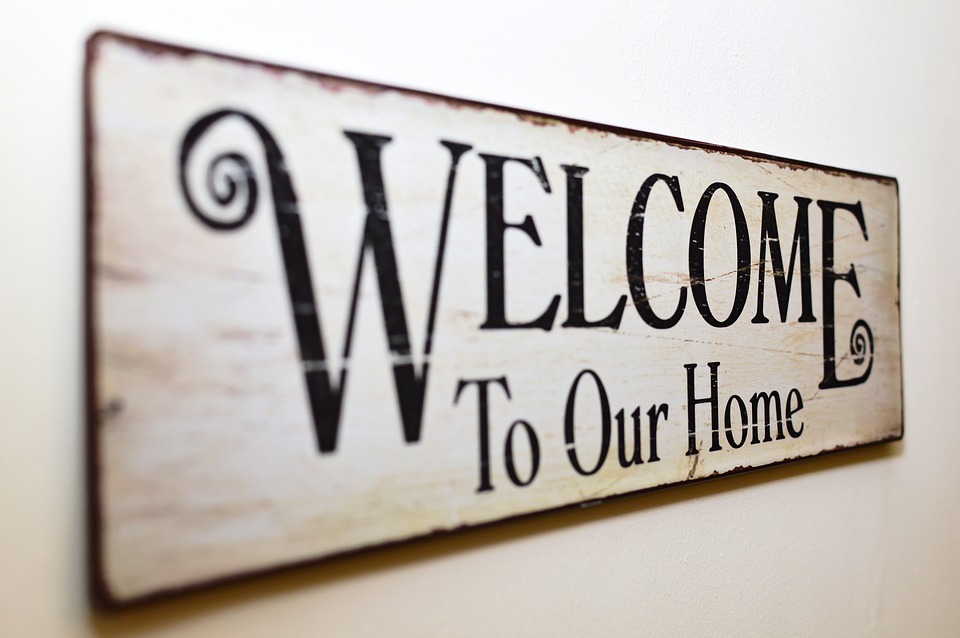
‘I’ve never seen anyone look so scared,’ says Marta. I’m speaking to a Polish friend that I’ve known for many years. She lives in Eastern Poland some fifteen miles from the border with Ukraine. In the last couple of days, she and her husband and two young sons have welcomed Viktoria, a Ukrainian mother from Kyiv with her eight-year-old daughter, into their home. Marta is calling me to ask me to pray for them all. ‘We need to remind them that God is still with them.’
Marta and her family live in a modest three-bedroom apartment. She’s so proud of her younger son, she tells me. He’s given up his own room and is sharing his older brother’s, to make space for their guests. Viktoria and her daughter have fled to Poland from Kyiv, travelling by car towards the border, finally walking the last few miles. Viktoria has left her doctor husband behind. She doesn’t know if or when she will see him, or her home, again. ‘She needs to make decisions about where to go and what to do,’ says Marta, ‘but just now she can’t decide anything.’
Since her arrival, Viktoria hasn’t touched any food. ‘I keep telling her that she must eat,’ comments Marta, ‘but she’s still too scared.’ Marta’s voice is cracking. ‘She says she isn’t hungry.’ Viktoria is frantic with worry about her two other children: two boys, aged 11 and 16, who were staying with relatives outside of Kyiv when war broke out and couldn’t return home. Viktoria has made it to Poland with her daughter, but the two boys, who have no papers with them, have still not arrived. Viktoria is terrified that even if the two boys successfully make their way to the Polish border, they might be turned away for not being able to prove their identity.
Two days later, Marta calls me again, relief in her voice, to let me know that Viktoria’s sons have arrived safely. Marta had accompanied Viktoria to the border to pick the two boys up, driving hours in the freezing dead of night.
The boys had bravely made their own way to Lvov. There, a member of a Ukrainian church had collected them from the station and driven them onwards towards the Polish border. The traffic jam was such that the two boys had to leave the vehicle several kilometres from the frontier. They made the rest of the journey on foot, trailing their luggage with them. When they eventually collapsed into Marta’s car, they fell asleep before the car doors had closed.
The season of Lent reaches from the desert at one end to the Cross at the other. In a bleak, wilderness landscape, Jesus faces a stark moral and spiritual choice. Refusing to bow down to the Tempter, he chooses to go God’s way, and those who dare follow him find themselves by the end of Holy Week at the foot of the Cross. ‘Behold, your mother,’ the crucified Jesus says from the Cross to the beloved disciple. The scripture tells us that from that day, that disciple takes Mary the mother of Jesus into his own home (John 19:27).
At one level, the Gospel of John speaks powerfully and theologically here of the New Community which comes into being through the sacrifice of Christ. ‘When I am lifted up from the earth,’ says Jesus, referring to his death on the Cross, ‘I shall draw everyone to myself.’ (John 12:32)
At another level, however, this story reminds us of the cost and practical calling of being beloved disciples. At the foot of the Cross, the beloved disciple is confronted by the horrific brutality of crucifixion – a penalty meted out by an occupying military power upon any deemed to threaten the machinery of its empire. Jesus doesn’t call his disciple to stand weeping, looking on. For the disciple, ‘beholding’ his new mother means welcoming her into his home. Seeing leads to responding.
The scripture never describes to us what it was like to offer that welcome to Jesus’ mother. John never tells us if Mary was too traumatised to eat or if members of the disciple’s household had to squeeze up to make room for her. We’re simply left with the silences between the lines that our experiences rise to fill.
This Lent, we find ourselves confronted by the desert which war brings. Which way to choose? As beloved disciples, we’re to be builders of God’s New Community. We’re to offer living response – however small or modest – not by uttering well-intentioned words, but through concrete action. Every act of kindness in the face of division is an act of defiance against the fear, greed and hatred that seek to destroy. Every gesture of welcome we offer to an outsider opens us to God’s costly work of reconciliation.
Please pray for the ministry of Marta and others like her, and for all those, fleeing for their lives, who seek welcome and new community.
Find out what a church near the Ukrainian border is doing to welcome refugees: https://marycotes.co.uk/2022/03/12/crossing-the-border-scenes-from-a-polish-church/
Find your copy of Women Without Walls here: https://www.bookdepository.com/Women-Without-Walls-Mary-Cotes/9789811471568?ref=grid-view&qid=1645452441503&sr=1-1
 Women Without Walls
Leave a comment