The seventh-century founder and leader of a community of both men and women, the refugee child who grew to be an advisor to kings: Hilda’s story has much to challenge us.
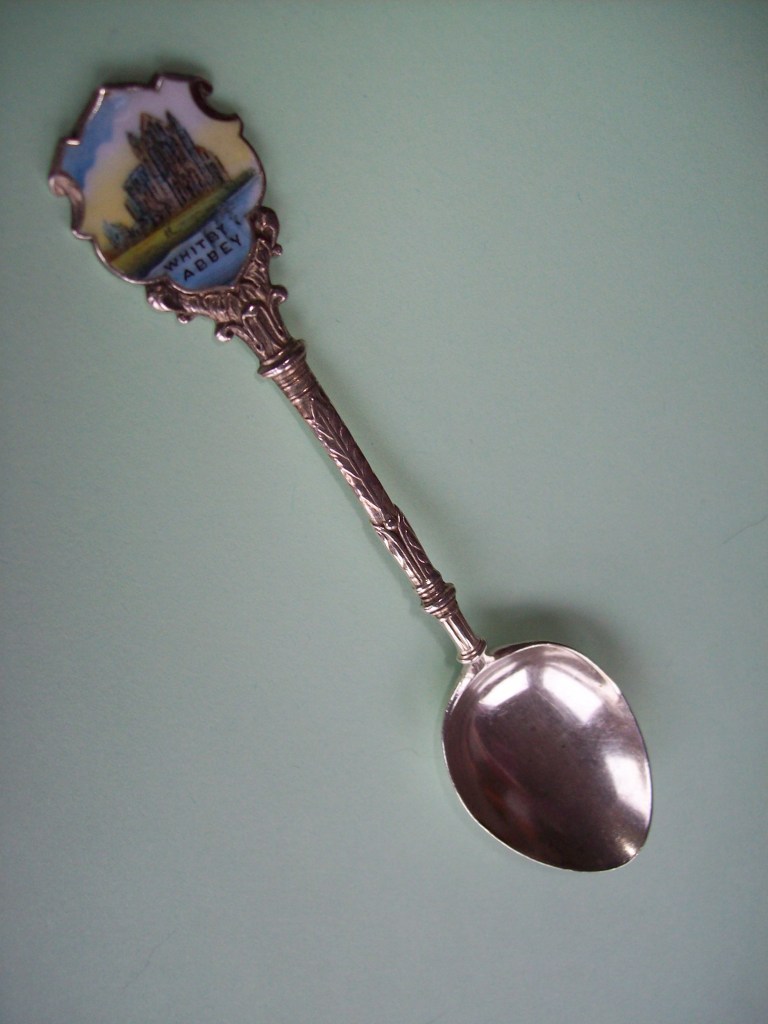
At home when I was growing up there was a particular teaspoon which often found its way into the jam jar. It was a souvenir of Whitby Abbey which my parents had brought home from a holiday in Yorkshire before I was born. I remember how astounded I was when, many years later, I discovered that the original Whitby Abbey had been founded by the seventh-century Christian saint, Hilda. What was more, she was the founding abbess not of a community of women, but of a double monastery in which men and women, living separately in small groups, gathered together for prayer and worship five times a day.
Many of the details of Hilda’s life are shrouded in the mists of time, but what is known about her is filled with drama. Hilda was born around 614 when the land now known as England was more like a patchwork of warring kingdoms. Hilda was of royal descent and, as a child, experienced the violent excesses to which human authority can go in the interests of greed and power. Her father Hereric had been murdered and she grew up in the court of her great-uncle, King Edwin. Some years later she and her mother fled south to East Anglia and lived in exile under the protection of a royal cousin.
A woman of authority
So how did she end up an abbess, exercising authority in the name of the Prince of Peace? Converted into the Celtic tradition of Christian faith, Hilda, it seems, was attracted to the idea of following her sister to France and living out her religious vocation there. However, Bishop Aidan persuaded Hilda to stay as a nun in Northumbria. It was not long before she held positions of authority. She was gifted both as an administrator and as a scholar and teacher.
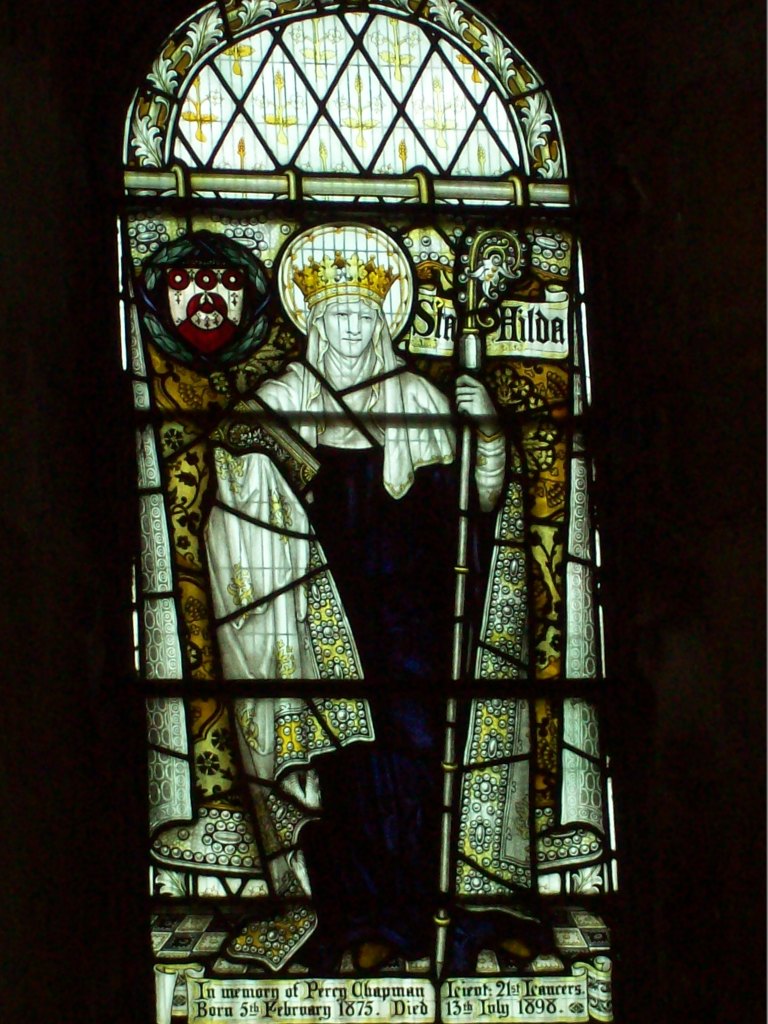
Oversight of the mixed community at Whitby, founded by her in 657, was not her first leadership role. In stained-glass windows, Hilda is often depicted holding a Bible or an Abbey church in one hand and a crozier (crook) in the other. While the crozier – the symbol of pastoral authority – may probably be more readily associated in many of our minds with a bishop, it is also held by the superiors of convents, and in Hilda’s hand speaks of the authority which this remarkable woman held. Open to women and men, the community also drew together people from different contexts. They shared all things in common and those from royal backgrounds enjoyed no special perks.
When we look down the patriarchal centuries at a Christian history that has little recognised the leadership of women, we can easily get caught up by the fact that Hilda had oversight of a mixed community. While this is very significant for us, it is equally important to look at the spirituality that underpinned the authority that was recognised within her.
Vulnerable, prayerful leadership
Anyone suffering the horrors Hilda had experienced as a child might well want to believe in a God who provides a cosy cocoon. However, when I visited the site of the Abbey back before the pandemic, nothing about its setting seemed to communicate cosiness! I was struck by its position on the raw edge of the cliff.
Sadly, the ruins which are to be found there today are not those of the Abbey she founded, which was abandoned at the time of a Danish invasion in 867. Cruelly exposed, especially in winter, to howling winds, biting cold and raging storms, its setting speaks of the greatness of the Creator and the smallness of human beings. Yet this was the very context in which deep and influential Christian community was to flourish.
At once facing inwards towards a land racked by explosive political tensions, and outwards towards the untameable expanses of sea and sky, prayer was the lifeline by which community members, not unlike the psalmists, must have offered to God the extremities of human experience. Sustained by the Celtic tradition, Hilda established a disciplined rhythm of prayer. At the heart of the community, monks and nuns spent their days in prayer and study.
Leadership seeking wholeness
Hilda clearly attracted people to this cliff-edge and to the kind of faith it stood for. The Abbey was open to the world: Simpson comments that it wasn’t impossible that Hilda had a monastery ship anchored in Whitby harbour(1). A woman of great intellectual brilliance, Hilda was well-known for the depth of her spirituality and her extraordinary wisdom. In 664 the Synod of Whitby – which would establish the date of Easter for the country – was held at the Abbey and some of the greatest church leaders of the time were received by Hilda.
But the Abbey did not only attract ecclesiastical figures. Kings sought Hilda’s counsel, and, under her guidance, the Abbey flourished, becoming the leading cultural and spiritual centre in the Anglo-Saxon world, known for its scholarship and erudition. This was a spirituality which recognised that mind and spirit, prayer and politics, belonged together.
The community founded by Hilda grew quickly and a large number of men and women were soon living there under Hilda’s authority and guidance. The Abbey might have seemed not unlike a village. The life of the religious community supported a much wider community of people who depended on the monastery for their livelihood and who looked after both land and livestock. A sacred balance was sought as members of the community, holding together faith and work, lived in relation to their environment.
Spirit-filled leadership
The life of the Abbey was further renowned for nurturing the gifting and calling of no less than five bishops. Yet Hilda is perhaps best-known for having discerned and encouraged the spiritual gifts of Caedmon: the first named poet to write in the English language. He was a simple man who looked after the community’s livestock. One night, he had a vision of God and began to sing. The following day, he was brought to Hilda.
Hilda discerned a significant spiritual gift within this man. Believing no doubt that the Spirit, like the wind at the cliff-edge, blows powerfully where God wills, Hilda understood the need to unlock the song within Caedmon without burdening him unnecessarily. Caedmon was illiterate, and Hilda decided to spare him Latin studies! She invited him to join the community and a few years later, he made his vows.
The challenges
I suspect that I shall not quickly find responses to the questions Hilda’s story seems to ask of me. As the child of a culture which continues to divide intellect from faith, spirituality from activity and faith from politics, how ready am I to believe in the God who reconciles all things in Christ? How willing am I to seek ways to help liberate another’s song? In a world shaped by centuries of patriarchy, how fundamentally confident am I in God’s calling on my life? St Paul speaks of the church as ‘ekklesia’ – a body of people ‘called out.’ How ready am I to be called out to live a ‘cliff-edge’ kind of spirituality?
Nowadays when I look at the souvenir spoon of Whitby Abbey, it seems that something vital is missing: Hilda’s name! If my parents never told me about her, it was probably because they didn’t really know enough to tell. The eighth century Church historian Bede(2), might wax lyrical about her, and academic institutions might adopt her name, but in general, stories of extraordinary Christian women like Hilda still rarely find their way into the pews. Yes, by the time I was a child, tales of the likes of Gladys Aylward who worked overseas were ‘safe’ to be told, but narratives about women who exercised authority nearer to home were still little known by ordinary Christians.
I am convinced that we need to hear more stories of exceptional women. As numerous scholars are increasingly finding, women like Hilda offer us significant models for today, and push us to keep asking why their names were air-brushed out of ‘important’ Christian history. Yet the task of telling and retelling these stories cannot be left simply to the scholars. The more we share them in our churches and with our children, the more we shall help create the environment in which women’s leadership is increasingly visible and celebrated, and in which we all learn from their great legacy.
An earlier version of this post can be found in French on the website of Servir Ensemble. https://servirensemble.com/2019/12/20/femme-eveque/
To find out more, read Ray Simpson’s book Hilda of Whitby: A spirituality for now; BRF, Abingdon, 2014.
Purchase your copy of Women Without Walls here: https://www.bookdepository.com/Women-Without-Walls-Mary-Cotes/9789811471568?ref=grid-view&qid=1645452441503&sr=1-1
NOTES: 1.Simpson, Hilda of Whitby: A spirituality for now, p.63. 2.Bede, The Ecclesiastical History of the English People, eds. Judith McClure and Roger Collins, OUP, Oxford, 2008, pp.210-18.

 Women Without Walls
Leave a comment